

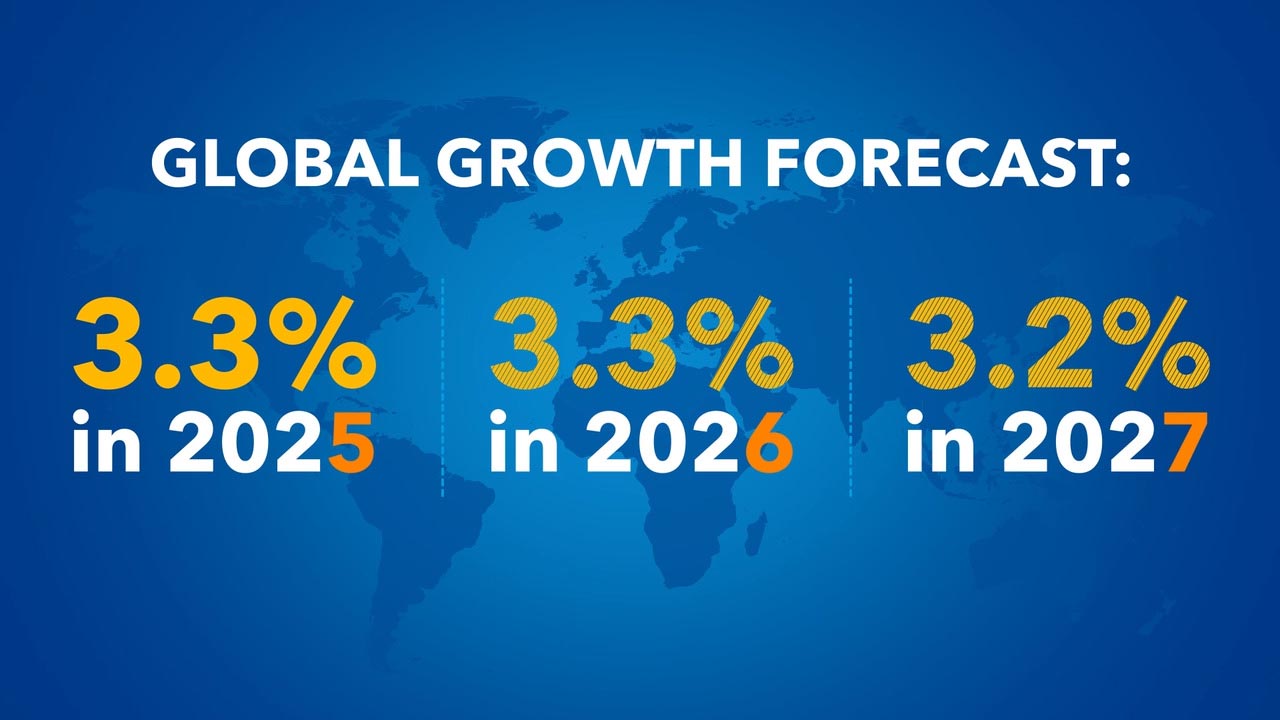
MBABANE – The global economy is expected to remain resilient over the next two years, but beneath the surface, powerful forces are reshaping growth, inflation, trade and financial stability.
According to the International Monetary Fund’s (IMF) World Economic Outlook Update for January 2026, world growth is projected at 3.3 per cent in 2026 and 3.2 per cent in 2027, broadly in line with 2025 performance
Although Eswatini is not mentioned directly in the report, the global trends outlined have important implications for the kingdom’s economy, businesses, investors and policymakers.
In an increasingly interconnected world, shifts in major economies, trade flows, energy prices, financial markets and technology investment inevitably affect smaller, open economies such as Eswatini.
The IMF notes that global growth is being supported by strong investment in technology, particularly artificial intelligence (AI), alongside accommodative financial conditions and fiscal support in several advanced economies.
These ‘tailwinds’ are offsetting headwinds from trade policy uncertainty, geopolitical tensions and high public debt levels. For Eswatini, this means the external environment remains mixed.
While global demand is not collapsing, it is also not booming.
Export-oriented sectors such as agriculture, manufacturing and textiles continue to depend heavily on economic conditions in major trading partners, especially South Africa, the European Union, the United States and Asia.
*…
Energy prices set to decline by about 7% in 2026
MBABANE – Energy prices are expected to decline by about 7 per cent in 2026 due to tepid global demand and strong supply growth, although OPEC+ policies are likely to prevent a sharp price collapse.
Lower oil and gas prices could benefit Eswatini by reducing fuel import costs, easing pressure on electricity generation and supporting lower inflation. This is particularly relevant as businesses and households continue to grapple with high energy costs and power supply challenges.
However, the IMF also notes that geopolitical tensions, especially in the Middle East or Ukraine, could disrupt shipping routes and supply chains, pushing commodity prices higher again. Such shocks would quickly filter through to fuel prices, food costs and transport expenses in Eswatini, reinforcing the need for energy diversification, renewable investments and stronger supply resilience.
Meanwhile, one of the most striking features of the current global recovery is the surge in technology-related investment, particularly in AI. The IMF estimates that AI-driven spending added about 0.3 percentage points to US GDP growth in 2025.
While Eswatini is not a major player in the global tech sector, the spillover effects of digital transformation are significant. Advances in AI, automation and digital services can improve productivity, support new business models and enhance service delivery across sectors such as finance, agriculture, education and healthcare.
The IMF suggests that rapid AI adoption could boost global growth by up to 0.3 percentage points in 2026 and between 0.1 and 0.8 percentage points per year in the medium term, provided complementary policies are in place.
*Full article available on Pressreader*


















Leave a comment