

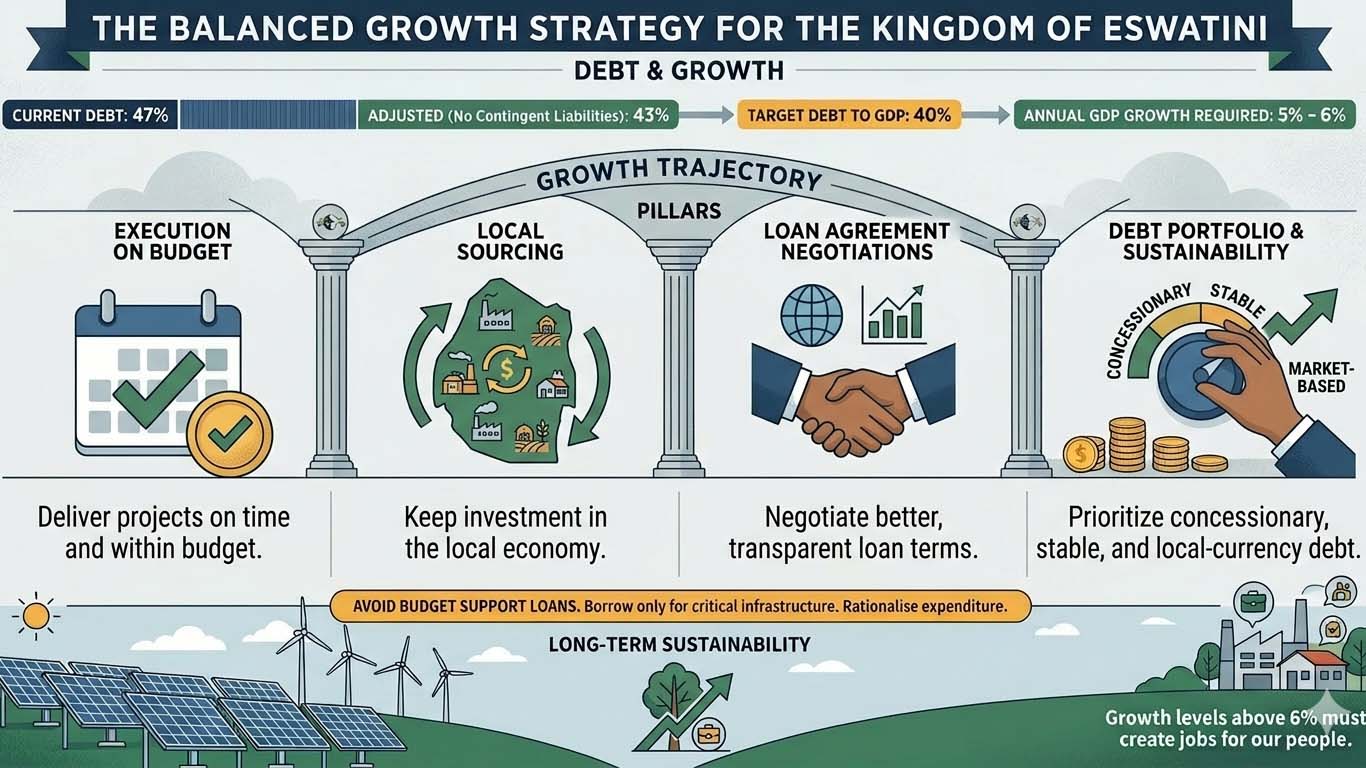
As we enter a phase of high debt levels estimated to be at 47 per cent by the end of this financial year, albeit that removal of contingent liabilities brings down the number to 43 per cent, the fact remains that government remains a guarantor and it always appears on the balance sheet and the debt to GDP ratio.
In economics one, every problem is a dual problem; this is to say a minimisation problem has a maximisation alternative. In this case, to get the debt to stabilise at 40 per cent we need to ensure that we maximise on the impact of the infrastructure projects to ensure that we get between five per cent and six per cent annual growth rate in GDP, so that debt stabilises to acceptable levels. To attain this, we need to ensure the following.
EXECUTION ON BUDGET
We often note with regret that public projects are often cursed with cost over-runs. This has to be a thing of the past; we need to deliver these projects on time and within budget. I was excited to learn that government has changed the contracting modality to ensure that projects will be completed on time and within budget. This will ensure that we are not paying more for new projects and we reap the full multiplier. Consequently, we will stay close to our growth trajectory and the economy grows, so that we are able to create the ability to repay our obligations as a nation.
LOCAL SOURCING
To improve the extent of the multiplier effect, local sourcing is imperative. The contracting authority needs to ensure that as much of the money is contained within the domestic economy so that it benefits the local economy. It is imperative that downstream and upstream industries benefit from these capital expenditures. We must craft the contracts in a manner that ensures local industries are involved in the value chain as part of the contractors or sub-contractors or support services. This will ensure that local companies are also sustained and assisted to grow through government capital expenditures. This is also a local business growth and development strategy so that they create the business and financial profiles to be able to get to a level where they can bid for the mega projects that the kingdom is entering, as we are entering a phase of mega projects. Local business is vital for long-term, sustained growth of the kingdom, as local industries have a long stay in the local economy.
LOAN AGREEMENT NEGOTIATIONS
One of the skills that we need to learn to develop as a country we need to learn to improve our contract negotiations with lenders. When we acquire bilateral loans, we must ensure that we do not enter into contracts with sourcing conditions. To efficiently implement our capital expenditures, we must have the leeway to source at will and choose a contractor at will. To this end, I strongly suggest that we shift towards market-based loans, such as listing in international stock exchanges and or utilising multilateral organisations, where we will be at liberty to use domestic procurement procedures and policies. This will enable us to improve local sourcing, develop local industries and reduce leakages, ultimately improving on the multiplier of each Lilangeni invested in capital projects.
AVOID BUDGET SUPPORT LOANS
Running the business of government must be supported by domestic revenue and SACU revenues. We cannot be borrowing to pay salaries and common-use purchase items within government. The daily operations of our civil service cannot be supported by budget support loans. I strongly urge government to reduce dependence on budget support loans. We need to be borrowing to invest in capital formation and setting up critical infrastructure for commerce and industry to thrive. In the long run, growth comes through private sector productivity. We cannot be perpetually building mega structures; at some point, the industry or private sector needs to lead the growth and we must grow through the private sector and sustainable jobs. Government must rationalise its expenditure to ensure that it all fits within domestically-mobilised sources. It is imperative that sources of savings be identified within the government machinery, while strengthening domestic tax collection and compliance.
DEBT PORTFOLIO
At this level, we have a burgeoning debt portfolio; it is imperative that we shift focus towards concessionary loans with low interest payments. We need to put a lid on the interest payment requirements, as we take up new debt, it must not add too much to our interest payments. Also, we need to try to negotiate our debt in the local currency or the South African Rand. This will make our debt predictable and not vulnerable to exchange rate fluctuations.
SUSTAINABILITY
Our debt stock requires that we shift focus towards growth orientation. Our major problem, given our current debt stock, now becomes growth. The economy must grow at levels above six per cent and must create jobs. To attain these levels of growth, the ministries of the economy must work together to ensure that these investments create long-term, sustainable growth. And we need jobs for our people; this way, the economy will grow through private sector investments and private consumption.


















Leave a comment