

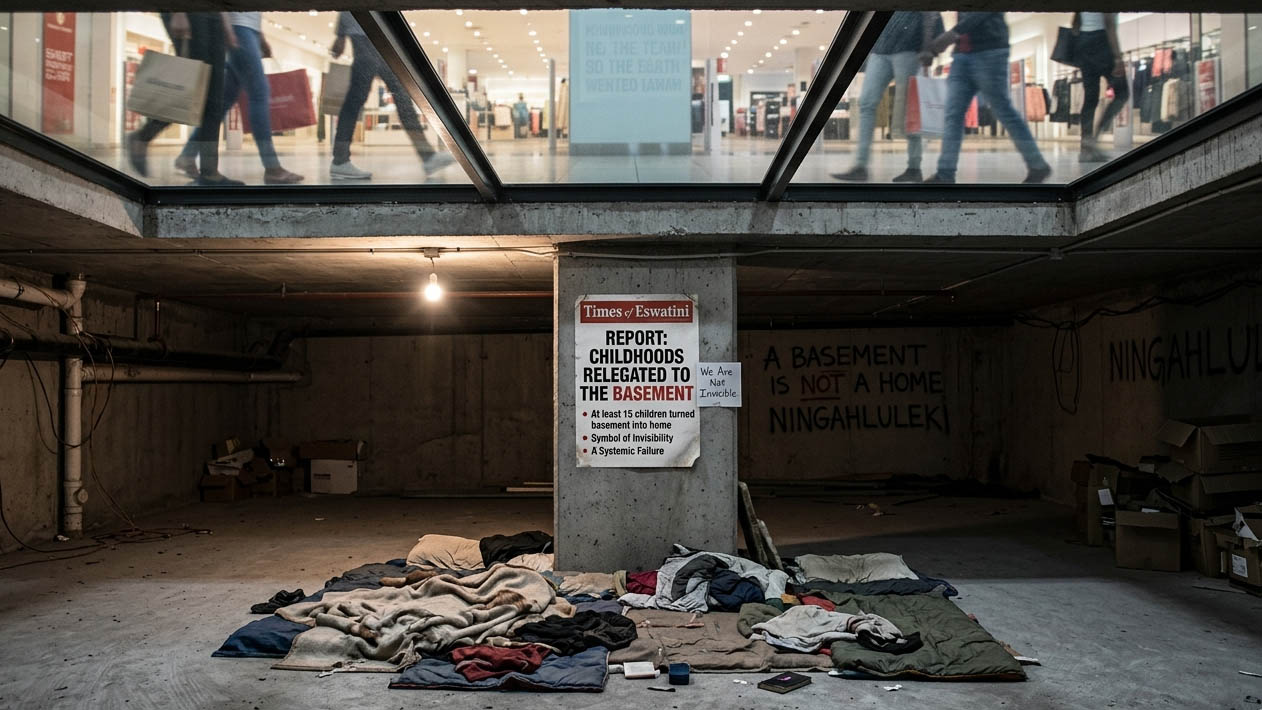
The recent report by Times of Eswatini detailing how at least 15 children have turned a mall basement into their home should unsettle every fibre of our national conscience. Beneath the ‘polished storefronts and steady hum of commerce’ in the country’s busy towns lies a hidden reality, one that is not only disturbing, but deeply indicting of the society we have become.
There is something particularly devastating about the fact that these are not adults navigating hardship, but children – young, vulnerable lives forced into conditions no child should ever know. A basement is not a home. It is a symbol of invisibility. Also, the fact that these children exist just metres below spaces of consumption and economic activity is not irony, it is a failure. A systemic one.
What does it say about us that children can sleep in a mall basement while shoppers move above, unaware or perhaps unwilling to confront what lies beneath? The article paints a picture not just of poverty, but of neglect and of a society that has allowed its most vulnerable to fall through every conceivable safety net.
This is not an isolated tragedy, but it is part of a pattern. When children begin to live outside the structures meant to protect them – family, school, community and State – it signals a breakdown across all levels of governance and social responsibility. These children are not choosing this life; they are surviving it. Survival, when it replaces childhood, leaves scars that do not fade easily.
The consequences of growing up in such conditions are both immediate and generational. Children raised in environments marked by instability, exposure to crime, lack of education and poor sanitation face heightened risks of mental health challenges, substance abuse and exploitation. Their development, emotional, cognitive and social, is compromised. In many cases, survival instincts override the nurturing of potential.
Even more concerning is what this means for the future of the children. If a growing number of them are raised on the streets, we are not merely witnessing a social issue, but incubating a future crisis. A generation disconnected from formal education, social structures and economic opportunity does not simply reintegrate later without consequence.
We have seen this before in different forms. The rise of unsafe ‘night care’ facilities, where children are crammed into unregulated spaces while parents work, was itself described as a symptom of a system failing its children – not the root cause. The basement children are another symptom, more visible, more jarring, but stemming from the same disease: Structural neglect.
At its core, this is about inequality and policy failure. It is about an economy that leaves families with impossible choices and about urbanisation without adequate social support systems. It is about child protection frameworks that exist on paper but fail in practice. It is also about a collective desensitisation that allows such realities to persist in plain sight.
We must resist the temptation to reduce this story to a moment of shock that fades with the news cycle. Outrage, if not followed by action, becomes complicity. The presence of children in a mall basement should trigger urgent, coordinated intervention – from social services, law enforcement, policymakers and community organisations. However, beyond immediate rescue, there must be a deeper reckoning.
Where are the systems meant to identify at-risk children before they end up here? Where are the community safety nets that once absorbed vulnerability? Perhaps most importantly, where is the political will to prioritise child welfare not as a peripheral concern, but as a central pillar of national development?
Because that is what this is. Not charity. Not crisis management but development. If we allow street-connected children to become a permanent feature of our urban landscape, we are normalising a future where inequality is entrenched, where crime becomes both a symptom and a response and where the promise of our nation is fundamentally eroded. No country can sustainably progress while its children are relegated to basements, both literally and figuratively.
This demands urgency, accountability and a refusal to look away.



















Leave a comment