

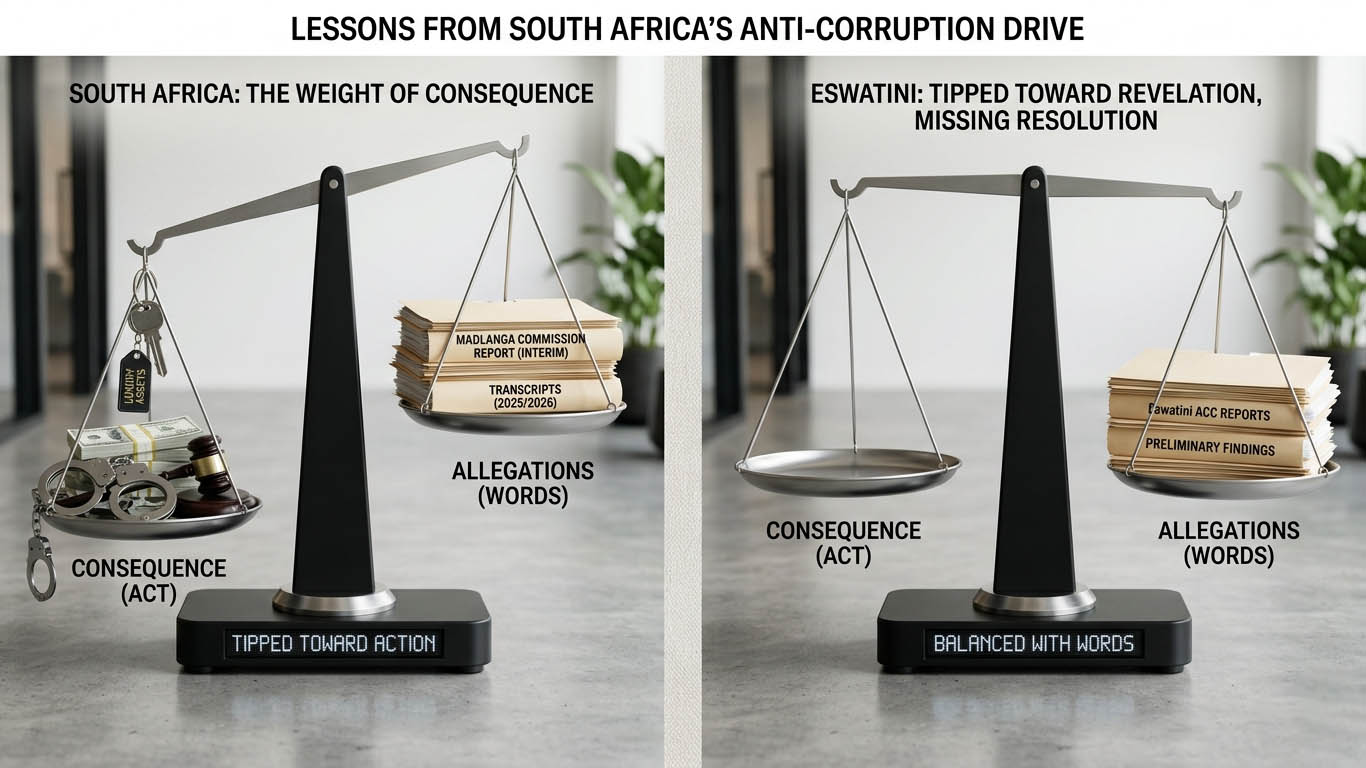
In a region often numbed by the slow grind of corruption investigations, recent developments in South Africa have offered something unusual: Consequence. Not just allegations, not just commissions, but arrests, frozen assets and a visible chain linking inquiry to accountability.
At the centre of this moment is the Madlanga Commission, a judicial inquiry established in 2025 to probe deep-seated allegations of criminality, political interference and corruption within the country’s criminal justice system. Its hearings unearthed troubling claims of organised crime syndicates infiltrating State institutions, of senior officials colluding with criminal actors and of public resources being manipulated for private gain.
What distinguishes this process is not merely the gravity of the allegations, but what has followed.
In March 2026, at least 12 senior police officers were arrested in connection with a E360 million tender scandal linked to businessman Vusimuzi Matlala. The case revolves around an allegedly irregularly awarded contract for police health services, with claims that bribes were paid and procurement laws were violated. Within weeks, the net widened: Senior figures, including National Police Commissioner Fannie Masemola, were charged under the Public Finance Management Act and appeared in court.
This is not a story of overnight justice. It is, instead, the product of months of investigations, interim reports and evidence-gathering processes that were crucially communicated to the public. The result is a rare alignment: Inquiry findings flowing into prosecutorial action.
Parallel to this, the Special Investigating Unit (SIU) has demonstrated a similarly assertive posture. In April 2026, it secured a preservation order freezing E76.5 million in assets – including properties and luxury vehicles linked to alleged corruption at Eskom. These were not abstract figures on paper; they were tangible assets, now immobilised as part of a broader effort to recover public funds.
Together, these developments illustrate something often demanded but seldom seen: A system that, while imperfect, is capable of moving from exposure to enforcement. Even at the highest levels, there are visible repercussions. South Africa President Cyril Ramaphosa has gone as far as suspending top officials pending investigations, emphasising the need to ‘prevent the abuse of office and the theft of public resources’. There is an important nuance here.
The Madlanga Commission itself does not arrest; it uncovers, then recommends and refers. The arrests are carried out by law enforcement structures acting on those findings. Yet to the public, what matters is the visible chain: Allegations → investigation → findings → arrests. That continuity builds something fragile but essential: Trust.
It is this continuity that invites reflection closer to home. In Eswatini, calls for accountability are neither new nor rare. Public discourse is often punctuated by frustration over alleged corruption in government and parastatals. Reports surface, suspicions circulate and occasionally investigations are announced. However, too often, the process appears to stall somewhere between revelation and resolution.
The Anti-Corruption Commission (ACC), tasked with leading this charge, is frequently criticised as lacking teeth. Not necessarily because it does nothing, but because its work seldom culminates in decisive, visible outcomes. Investigations may take place, but arrests are sporadic; findings, if produced, are not always translated into prosecutorial action with urgency.
This contrast with South Africa is not meant to romanticise its system. Indeed, the very need for commissions like Madlanga highlights the depth of the problem. Corruption there is systemic and complex. What the recent developments demonstrate is a willingness, however uneven, to confront that reality publicly and act upon it.
The lesson for Eswatini is not that corruption can be eradicated overnight, nor that commissions alone are the answer. Rather, it is that credibility in anti-corruption efforts is built on follow-through. Investigations must lead somewhere. Findings must be seen to matter. Equally important is transparency. South Africa’s approach, publishing interim findings, allowing public scrutiny and proceeding with arrests, creates a narrative of accountability. It signals that the State is not merely aware of wrongdoing, but is actively responding to it. For Eswatini, strengthening anti-corruption efforts may, therefore, lie less in creating new structures and more in empowering existing ones: Ensuring independence, resourcing investigations adequately and fostering collaboration between investigative bodies and prosecutors. Most critically, it requires political will – the kind that allows even powerful individuals to be held to account.
There is a quiet power in seeing justice not just promised but enacted. It reminds citizens that institutions can work, that wrongdoing can have consequences and that the rule of law is more than an aspiration. South Africa’s current moment is not a conclusion, it is a test. Whether these arrests lead to convictions and whether systemic reform follows remains to be seen. Even in its incompleteness, it offers a glimpse of what is possible.
For Eswatini, the question is not whether corruption exists; it does. The question is whether the systems in place are prepared to pursue it to its logical end.
Until then, the calls for accountability will continue to echo.



















Leave a comment