

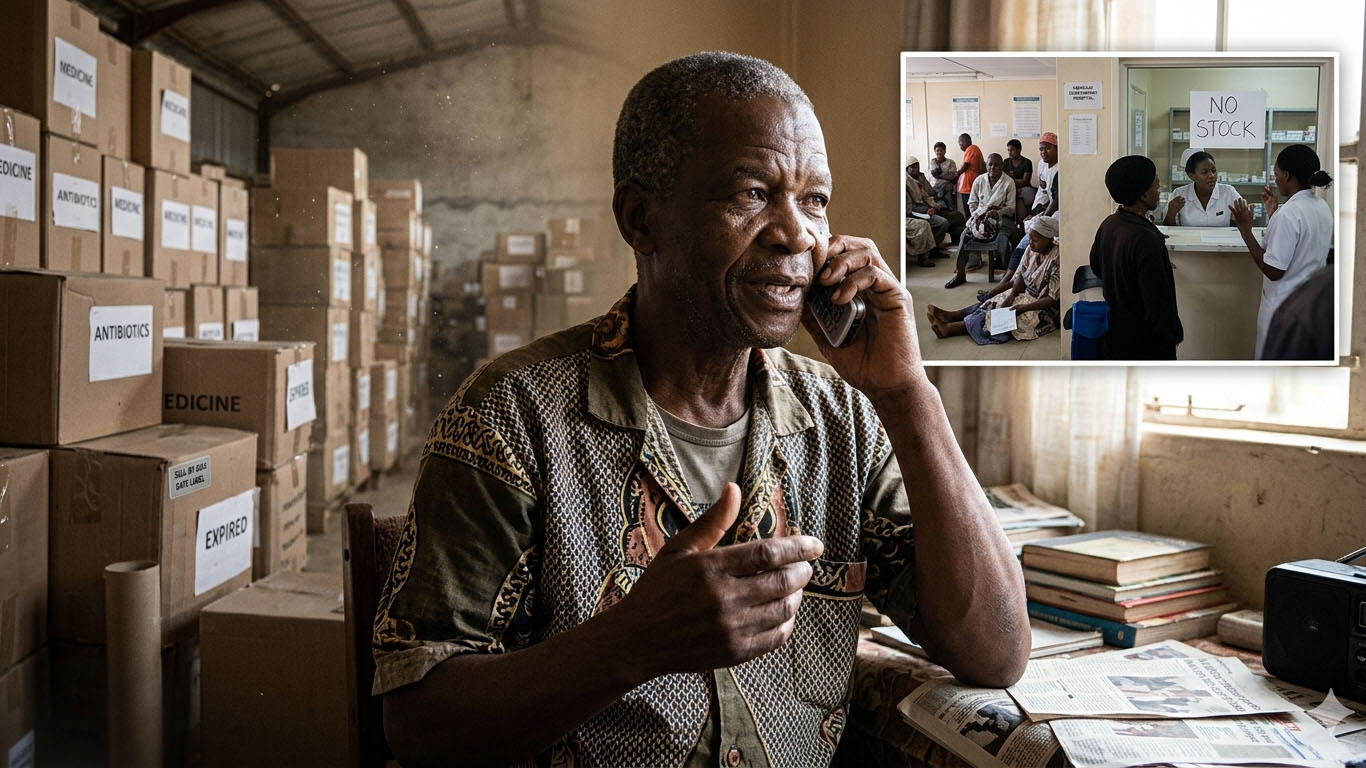
I have a cousin called Sibusiso. Every family in Eswatini has a Sibusiso. He is not a doctor, an economist or a politician, but he has strong opinions on all three.
Sibusiso is the type of man who can explain the national budget, Manchester United’s problems and cattle diseases in one conversation and somehow sound convincing throughout. So after reading Parliament’s report on Mbabane Government Hospital, I called him because I needed help.
Not understanding the report. Understanding reality. “Sbu,” I said. “Please explain something to me.”
He responded with the usual ‘What now?’
As absurd as it sounds, I said: “Parliament says hospitals are facing medicine shortages.”
He said: “That sounds about right.” I said: “It also says medicine worth E110 million expired in storage.” There was silence. The kind of silence that happens when somebody asks a question so ridiculous that your brain temporarily leaves your body.
Eventually, Sibusiso spoke and maybe the medicine got lost. “E110 million worth of medicine?” “Big warehouse.” “Sbu, patients were being told there were shortages.” “Then maybe the medicine was social distancing.” At this point, I realised Sibusiso understood the situation just as well as the people responsible for it, because nobody seems capable of explaining how patients can be looking for medicine while medicine is looking for patients. Think about that. A patient arrives at the hospital. No medicine. A nurse apologises. The family borrows money. The patient is sent to a private pharmacy.
Meanwhile, somewhere in a warehouse, boxes of medicine are quietly approaching retirement. The medicine completed its entire life journey. Manufactured. Delivered. Stored. Expired. Buried.
All without meeting a single patient. If those medicines could speak, they would probably file a complaint. “We heard there was a shortage, there was. We heard people needed treatment; they did. So why didn’t you send us? Please direct your query to the relevant department.” I moved on. “Sbu, the Ministry of Health requested 400 posts.” “Good.” “Government approved 11.” There was another silence. Longer this time. I could almost hear him removing the phone from his ear to check whether I was joking. “How many? 11 out of 400?” “Yes.” “Maybe they only read the first page.” Now listen. I don’t know much about workforce planning, but I know enough to recognise when somebody orders a cow and receives a chicken. Four hundred requested. Eleven approved. That is not recruitment. That is a sample size. That is not solving a staffing crisis.
That is the staffing equivalent of giving somebody with a broken leg a plaster.
Technically, something was done. Practically nothing changed. Sibusiso was now fully invested. “So, what happened next?” I continued reading. “The report says 600 nurses have left the public healthcare system.” Sibusiso laughed. Not because it was funny, but sometimes laughter is all that remains when logic has packed its bags and left. “At this rate,” he said, “soon the nurses will be treating each other because there will be nobody else left.” And honestly, who can blame them? Imagine showing up for work every day knowing the hospital is short-staffed. Short on medicine. Short on equipment. Short on fuel. Short on vehicles. At some point, the only thing the hospital is not short on is meetings. The report says nurses are witnessing preventable deaths. Preventable. Not unavoidable. Preventable. That word hit me harder than any statistic, because it means somewhere between identifying a problem and fixing it, the system simply stopped functioning. I kept reading. Then I reached the section about ambulances.
“Sbu.” “What now?” “The report says fuel shortages are disrupting ambulance services.” “Fuel shortages?” “Fuel shortages.” “For ambulances?” “For ambulances.”
Another silence. “Maybe they should push them.”
I laughed. Then I stopped laughing, because somewhere in Eswatini, there is a family waiting for an ambulance that cannot move because the vehicle responsible for emergencies is having its own emergency. The report says some vehicles are unroadworthy. Others are affected by fuel shortages. Referrals are delayed. Outreach programmes are affected. Patients suffer. Sibusiso sighed.
“You know what the real problem is?” “What?” “Nobody owns the problem.” And for once, Sibusiso sounded wiser than Parliament, because the report reads like a relay race of responsibility.
Health points at Finance. Finance points at procedures. Procedures point to regulations. Regulations point to approvals. Approvals point to committees. Committees point to reports. Reports point to recommendations.
Meanwhile, patients point at hospital queues. The truly frightening thing is how normal all this has become. Every family knows somebody affected. The grandmother who could not get medication.
The uncle whose operation was postponed. The neighbour had been referred three times before receiving treatment. The nurse who finally resigned. The family forced to buy supplies that should have been available in a public hospital.
These stories are no longer shocking. They are ordinary. And that should terrify us, because when dysfunction becomes normal, accountability becomes optional. I asked Sibusiso what he thought should happen. He did not hesitate. “Somebody must stop explaining the problem and start fixing it.”
Simple. Direct. No benchmarking exercises. No stakeholder engagement workshop. No strategic framework. Just action. Parliament’s committee has done its job. The nurses have done their job. The hospital staff have done their job. Even the expired medicines have done their job. They sat in storage until they could no longer sit. The only unanswered question is whether the people responsible for fixing these problems will do theirs, because if a country can experience medicine shortages while E110 million worth of medicine expires in storage, approve 11 out of 400 desperately needed health posts and lose 600 nurses while patients continue to queue for care, then the crisis is no longer a mystery.
The diagnosis is obvious. The symptoms are obvious. Even Sibusiso understands it. And whenever a problem becomes so obvious that Sibusiso understands it, the rest of us should be very worried indeed.


















Leave a comment