

MBABANE – Eswatini and other Southern African countries face a growing need for heat preparedness as a powerful El Niño is forecast to drive unusually high global temperatures through early 2027.
The Climate Impact Lab projects that 451 000 people could die from extreme heat during the first nine months of the current El Niño, compared with a normal year.
The projections come as the World Meteorological Organisation (WMO) says El Niño is firmly established and expected to intensify, with an exceptionally high likelihood that it will persist through February 2027.
The Climate Impact Lab estimates that global land temperatures could be 1.2°C above normal in the coming months, with the unusually warm conditions expected to produce 44 per cent more extremely hot days than in an average year.
It describes the event as a ‘postcard from the future’, because the temperatures experienced during the El Niño are similar to conditions climate models project to become normal about two decades from now.
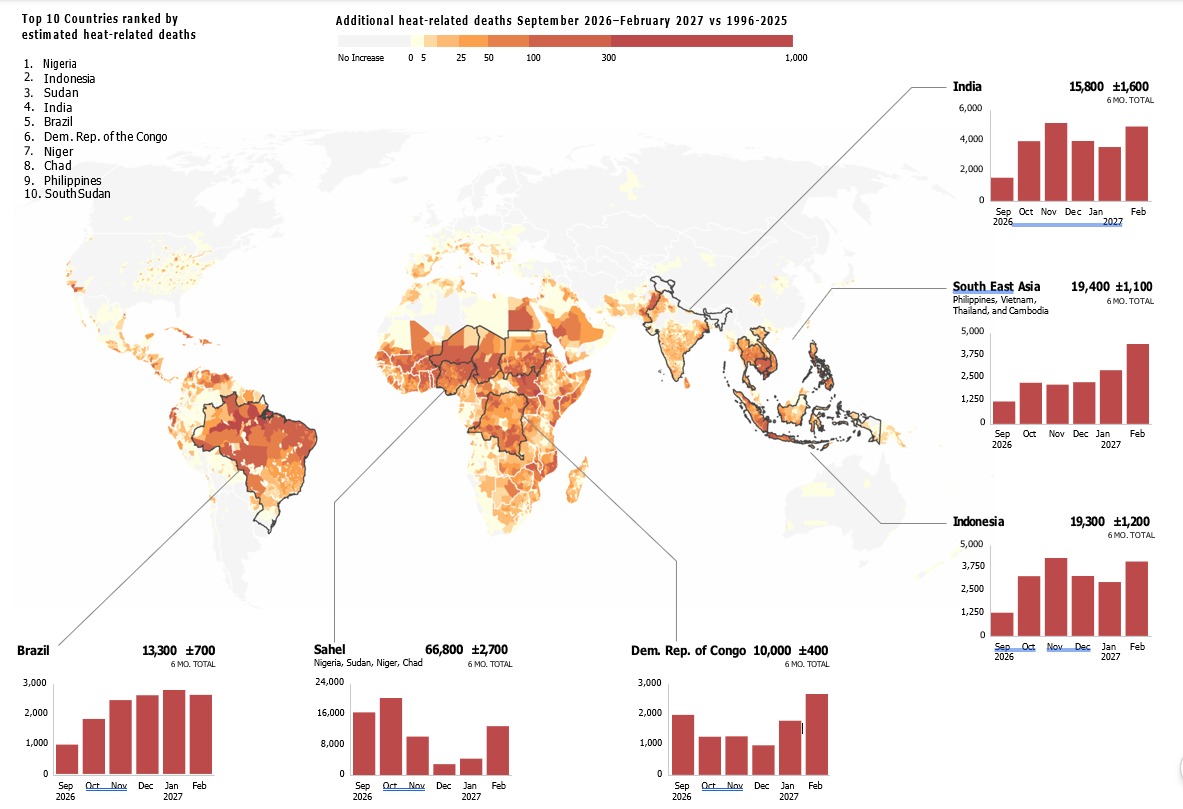
For the next six months alone, from September 2026 to February 2027, the research estimates 239 000 additional heat-related deaths, with an uncertainty range of about 11 000 deaths.
The burden is expected to fall disproportionately on the Global South, with several African countries among those projected to experience substantial increases in heat-related deaths.
Across the Sahel, the report projects 66 800 additional heat deaths, including 31 400 in Nigeria, 17 500 in Sudan, 10 000 in Niger and 8 000 in Chad.
The projections also identify major increases in heat-related deaths in South-East Asia, India and Brazil.
While the report does not provide a specific estimate for Eswatini or the Southern African Development Community (SADC), its findings are relevant to the region because El Niño can alter temperature and rainfall patterns across southern Africa.
The WMO has warned that a very strong El Niño can significantly shift global rainfall and temperature patterns, increasing risks associated with extreme heat, droughts, floods and other weather extremes.
The organisation’s September outlook indicates a strong likelihood of above-normal temperatures across almost all land areas globally during September to November 2026.
For Eswatini, the warning comes as the country and its neighbours contend with the wider effects of a changing climate, making preparedness for extreme temperatures increasingly important for communities, health services, outdoor workers and vulnerable people.
The Climate Impact Lab says governments do not have to wait for deaths to occur before acting.
It identifies heat-warning systems, health outreach to vulnerable people, cooling centres, hydration stations, worker protections and increased health-system capacity among measures that can help reduce the human cost of extreme heat.
The research also points to anticipatory financing, heat action plans, improved temperature forecasting and greater access to cooling technologies as measures that can help communities prepare before extreme temperatures arrive.
The mortality projections were developed using research covering 24 378 regions worldwide, combining temperature-related mortality relationships with long-range forecasts from the European Centre for Medium-Range Weather Forecasts.
The researchers compared projected heat-related deaths with the average for the corresponding months between 1996 and 2025, while accounting for differences in local climate, vulnerability and adaptive capacity.
The researchers caution that the 451 000 figure is not a prediction of deaths already occurring, but an estimate of additional heat-related deaths associated with the current El Niño compared with a normal year.
The estimate is also expected to increase if unusually warm conditions persist beyond the current six-month forecasting window.
With forecasts indicating that El Niño could persist into 2027, the report argues that governments have a window to strengthen preparedness and reduce avoidable deaths.
Eswatini, among other countries, is informed by the broader warning that heat preparedness needs to accompany drought, flood and other climate-risk planning, particularly as extreme temperatures that are currently considered unusual could become increasingly common in coming decades.
The Climate Impact Lab says the immediate projections offer decision-makers an opportunity to direct resources towards areas and populations most exposed to extreme heat before the deaths occur.
Who is most vulnerable to extreme heat?
Extreme heat does not affect everyone equally. People’s vulnerability depends on factors including their health, age, living conditions, occupation and ability to access water, shade, cooling and healthcare.
- Older people can face greater risks because the body’s ability to regulate temperature can decline with age.
- Children are also vulnerable, particularly when temperatures remain high for prolonged periods.
- Outdoor workers can face prolonged exposure because many occupations require people to work in direct sunlight or physically demanding conditions.
- People with limited access to cooling, clean water or suitable shelter can also be more exposed during periods of extreme heat.
- Urban residents may face additional exposure where buildings, roads and other surfaces retain heat.
How can heat deaths be prevented?
The Climate Impact Lab identifies several measures that can help reduce the risks associated with dangerous heat.
- Heat-warning systems can alert communities and health authorities before periods of extreme temperatures occur.
- Hydration stations can improve access to drinking water, particularly for people who spend long periods outdoors.
- Cooling centres can provide people with places where they can escape dangerous temperatures.
- Health outreach can help authorities identify and assist people who are particularly vulnerable during heat events.
- Worker protections can reduce exposure among people whose jobs require them to work outdoors or in hot environments.
- Health-system preparedness is also important, allowing medical facilities to respond to increased cases of heat-related illness.


















Leave a comment