
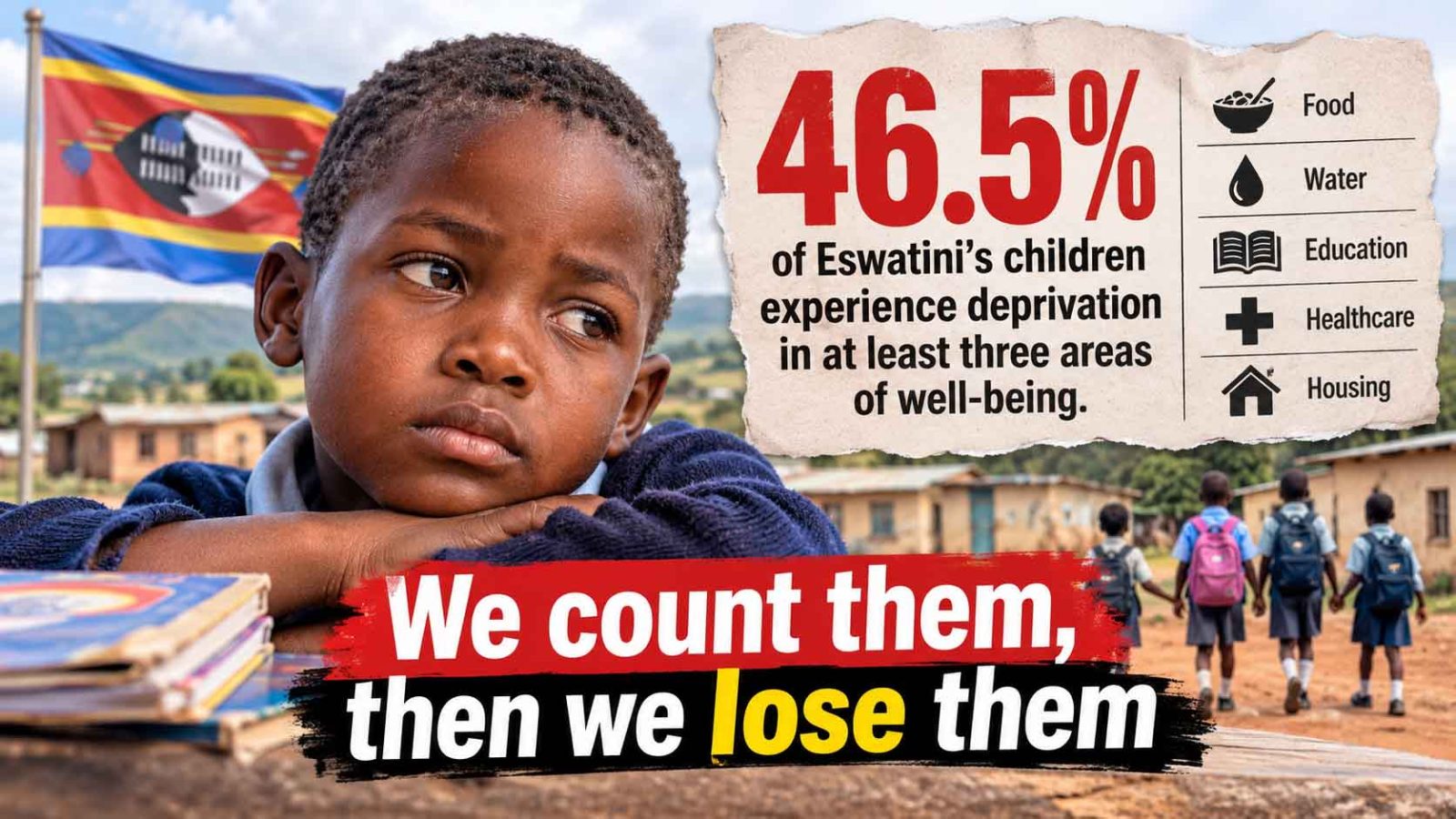
I keep thinking about one number. I can’t shake it. 46.5 per cent.
That’s the proportion of Eswatini’s children experiencing deprivation in at least three areas of well-being, according to a child poverty assessment. Food. Water. Education. Healthcare. Housing. Poverty doesn’t arrive alone. It brings relatives. Hunger brings disease. Disease brings missed school days. Poor sanitation makes everything worse. And government brings a questionnaire.
Lubombo stands at 55.4 per cent. Shiselweni at 53.9 per cent. Hhohho, the least affected region, stands at 39.5 per cent. Four in 10 children. In our best region.
Imagine four in 10 pupils struggling. Their head teacher calls it a success. In most jobs, that would trigger an emergency meeting. In government, it might qualify him to chair one. And deprivation starts before children can complain about it. Among children under two, 77 per cent experienced nutrition deprivation. Among those aged two to four, 95.8 per cent experienced early-learning deprivation.
We’re preparing children for the Fourth Industrial Revolution. Some are waiting for their first picture book.
Then there are birth certificates. The assessment found that 66.6 per cent of children under two experienced birth-registration deprivation. A child can spend her first two years here without a birth certificate. Government will eventually discover her. Probably during a census. Hunger doesn’t wait for disease to finish its shift. Dirty water doesn’t require a memorandum of understanding with poor sanitation. They work together without a committee meeting. One ministry handles water. Another handles health. Another handles education. Another handles social welfare. The child has hunger, illness and no books.
Poverty has a better Cabinet than government trying to defeat it. Take the orphaned and vulnerable children (OVC) grant. Find the vulnerable child. Pay her school fees. Keep her in class.
But a government-commissioned diagnostic study found that nine in 10 guardians in a sample involving children classified as needy could afford school fees. Researchers reported allegations that some head teachers registered ineligible pupils without their parents’ knowledge.
The parents pay. Government pays. The school allegedly receives both payments. We’ve invented a new category of vulnerable child. One whose parents can afford school fees, but whose school could use the money. The child who actually needs the money can always apply for sympathy. Apparently, that is still free. Knowingly diverting assistance intended for vulnerable children isn’t resourcefulness. If established, it could amount to fraud wearing a school tie. The Eswatini Principals’ Association said it was hearing about the allegations for the first time. Of course. Our national superpower is strategic surprise.
But blaming head teachers alone misses the system. Researchers found that some social workers assessed applications from their desks because they lacked transport, staff and clear procedures. Schools help determine eligibility. Those same schools may benefit financially when applications succeed.
We ask the fox to count the chickens. Then we audit the fox’s handwriting. Financial regulations for the OVC fund were drafted in 2020, but had not been adopted when researchers examined the programme. A child born that year is now six. She has learnt to walk, talk and perhaps read. The regulations are still crawling.
In 2016/17, administrative records indicated that 52 632 beneficiaries received E142 million. A household survey estimated 17 600 beneficiaries. The difference was 35 032. Different methods may explain the discrepancy. It proves neither fictitious beneficiaries nor theft. But it demands an explanation.
Thirty-five thousand isn’t a rounding error. It’s an unanswered question with a government department attached. We commission reports, launch them and photograph officials holding them. Then we organise workshops to discuss their recommendations. At this rate, the children studied will have children before implementation begins. Their grandchildren may qualify for the next survey. Three generations of poverty. One successful research programme.
Rwanda has integrated birth registration into health facilities. Brazil’s Bolsa Família links assistance to schooling and healthcare requirements. Neither is perfect. Both show that services can be organised around families instead of making families chase departments.
Eswatini doesn’t need another pilot that becomes a substitute for action. Before the next school term, the ministry responsible for OVC grants should publish a timetable for independent eligibility checks. Parliament should demand an explanation of the 35 032 discrepancies. Health and Home Affairs should set registration targets.
A deadline. A name. An answer. Before another generation grows up. We failed her as a child. Failed her as a pupil. Then, when she became an unemployed adult, we called her a burden on the economy.
Apparently, government can fail you at every stage of life and still expect you to apologise for the outcome. Behind that 46.5 per cent are children who cannot postpone growing up until government finishes consulting. Childhood has no extension period. A child cannot return at 25 to collect the nutrition she missed at two.
Meanwhile, the counting continues. We count children without books. Children without birth certificates. Children without adequate nutrition. And we are not innocent either.
We share the photographs. Applaud the launches. Express outrage until something more entertaining appears on our phones. Then we move on. The children do not.
One day, these children will grow up. Some will be unemployed. Some will have children facing deprivation.
Government will commission another study. We will publish the findings. Everybody will express concern.
And somebody will promise that no child will be left behind.
Technically, that will be true.
We never took them anywhere in the first place.