

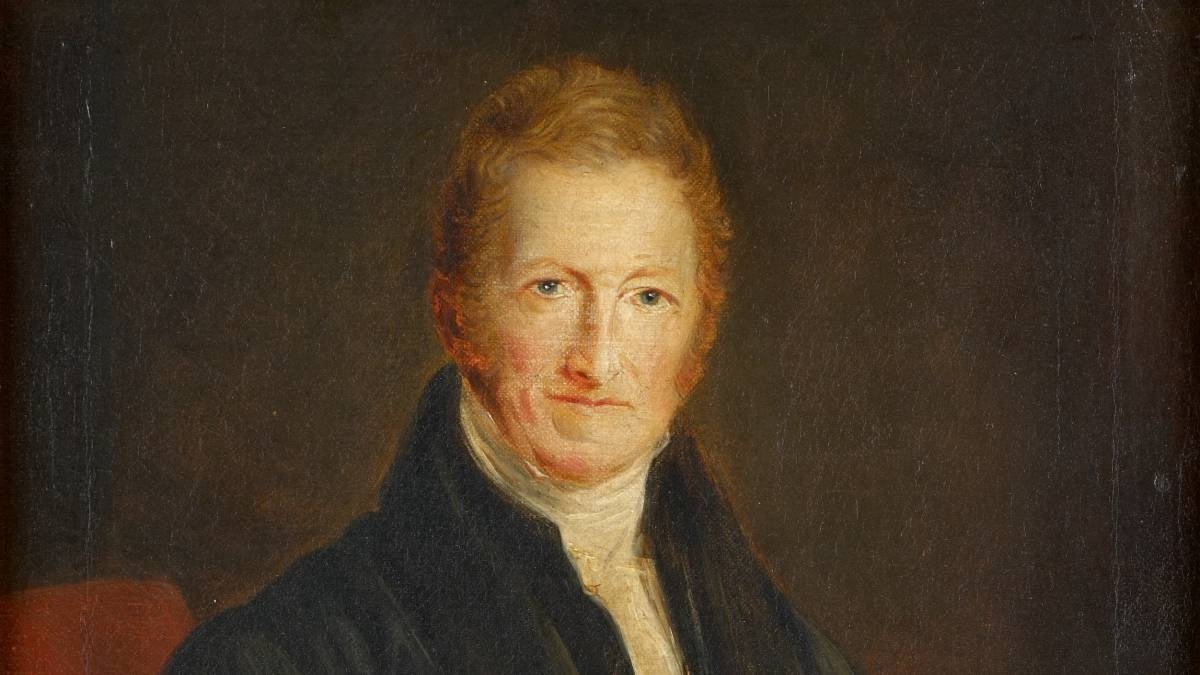
I remember the prediction of Thomas Malthus, the highly influential English economic and political thinker, that the food in the world would never be enough for the people in it. I’d better rephrase that. I’ve been around a while, but I didn’t actually hear Malthus say it. His prophetic words were captured in a book he published in 1796 when I wasn’t yet on the planet. Not even thought about.
His statement was rather more detailed. It was that the world population would keep increasing to absorb the increases in food supply that had been calculated to feed the existing numbers to a reasonable standard. That came to be known as the ‘Malthusian trap’ which, he claimed, would lead to the poorer classes suffering hardship and disease, giving rise to the ‘Malthusian catastrophe’.
To resolve that, he argued, there should be strict limits on human reproduction. Well, as we know, the Industrial Revolution and technological innovation have found a practical solution to food supply. However, they haven’t taught the entire global population to behave honestly and empathetically; ensuring that all are fed to a decent standard. Furthermore, imposing limits to human reproduction carries practical drawbacks and is morally wrong anyway. From the 1970s to 2015, China limited each family to one child; but that failed. Additionally, by 2099, it will have a population that is down to one third of India’s. We never thought that would happen.
Talking recently to a young guy from over the border and evidently highly experienced in information technology, we shared views on actual inventions such as AI and potential ones, such as an artificial brain for human beings. We both agreed that such an invention would be the worst for our world since the atomic bomb. I suggested we might worry a little about the future for our children. He said: “My fiancée and I are not going to have any.”
That’s an example of a notable shift in social behaviour that is happening in some countries. Go back a couple of centuries and the average human being would have said that having children was an important contribution that a couple could make to the future of society. That is, giving life to keep the human race going. Today though, many young people are deliberately planning not to have children. Does that mean the world population will decline substantially?
Not necessarily; for a while, the actual global population growth rate is estimated to decline to zero by the end of this century. In some countries, population shrinkage has been notable and getting more than a little alarming. There are many others, especially in Africa and among minority groups in some first world countries, where the population is actually rising. Most conspicuous among the ‘shrinking’ countries are Japan, where the actual population is reducing at a rate of 0.5 per cent per annum and China, down by 0.2 per cent per annum. By 2050, Europe’s population will be declining by 0.3 per cent per annum. That‘s the result of respective fertility rates, best summarised by a global reduction rate declining from 5.3 in 1963 to 2.2 in 2023. The 2.2 figure for every woman of child-bearing age is what’s required to keep the population growth rate at zero.
Most societies, especially the wealthy ones, have figures lower than that. In a social welfare State, it is arguably justified to impose limits on welfare payments to families above a certain size. However, do not impose a law that limits the number of children to one, as did China. In the modern age, freedom of choice has motivated many to not have children. The reasons include, firstly, financial freedom. There is thus no spending on the upkeep and education of children; that representing a significant portion of the average family budget. There is also a personal freedom that is entirely available to the two members of a childless partnership. Additionally, not having to allocate a substantial amount of time to giving children an active and productive upbringing leaves plenty for personal career development; especially women. Those perceived advantages are captured in the modern and popularised acronym DINK – double income, no children.
A shrinking population means more resources allocated to the population and higher per capita wealth levels. It reduces pollution and environmental degradation. But it also – especially in the short to medium-term – gives rise to an ageing population and a shrinking workforce. There is a smaller proportion of wealth-creating individuals. Without a productivity increase – perhaps through a substantial AI intervention – this would cause a decline in national GDP and the public purse; giving rise to reduced social welfare benefits and essential government programmes.
In many developing countries – Niger and Angola have high population growth rates – there is a strong traditional approach to family development. Especially prominent is the cultural dimension for children to expect to look after parents. This is especially when the latter grow old and, in the absence of adequate social welfare benefits, face a much-reduced income, added to the physical challenges of age. The more children in a family, the more substantial the available support for the elderly; thus strong population growth rates.
In the final analysis, the Malthusian trap is less to worry about than the political instability, human selfishness and periodic pandemics that remain threats to the future human society. Let’s hope a broader political empathy, with a good and sensible rate of technological innovation, can eliminate the starvation encountered by so many.



















Leave a comment