

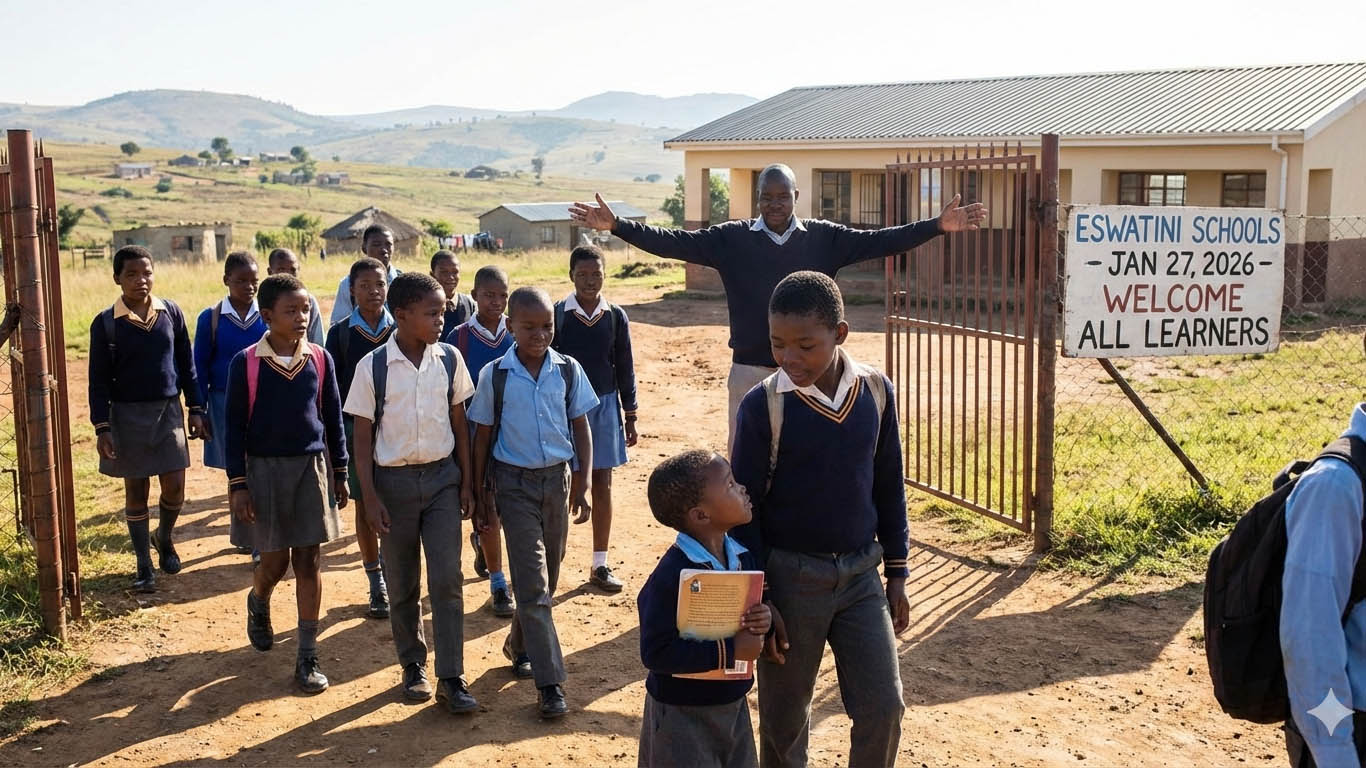
The schools are opening on the January 27, 2026. I would like us to think aloud about why all stakeholders in the education sector should ensure that no child, whether a liSwati or foreigner, should be left out.
As per norm, this period is challenging to parents whose children seek admission in schools, including those seeking Grade I admission. The urban schools in particular tend to be overwhelmed with requests for admission because every parent targets schools that produce good results. Those who seek admission in form I and form IV are also frantically looking for spaces. It is unfortunate that those schools that perform better in external exams tend to be overwhelmed with requests. Of course, the criteria they often use is that the best performing pupils get admitted, while those who had poor symbols struggle to be admitted.
I would like to appeal to school principals, school and admission committees to practice fairness as they consider requests. The Sustainable Development Goals made a clarion call that no one should remain behind in development. In this case, no child should be left behind in accessing education in Eswatini.
We are grateful that the drafters of the 2005 Constitution committed government to provide free primary education. We all recall that for government to comply, a civil society organisation had to approach the courts. Hence, it is regrettable that the disbursements of grants to schools have been so erratic over the years that many schools have struggled to operate. Feeding programmes have also been erratic as well.
We also commend government for having responded to the HIV/AIDS crisis with a grant to support the orphaned and vulnerable children (OVC). This OVC grant has provided a lifeline for orphaned and those children whose parents and guardians are struggling due to unemployment and poverty.
I would like to argue that education is a door out of poverty. According to Concern Worldwide US: “Access to high-quality primary education and supporting child well-being is a globally-recognised solution to the cycle of poverty. This is, in part, because it also addresses many of the other issues that keep communities vulnerable”.
Education is often referred to as the great equaliser: It can open the door to jobs, resources, and skills that help a person not only survive, but thrive. In fact, according to UNESCO, if all students in low-income countries had just basic reading skills (nothing else), an estimated 171 million people could escape extreme poverty. If all adults completed secondary education, we could cut the global poverty rate by more than half”.
In the 70s for example, poverty in rural areas was visible. Families struggled to have decent houses, but once a household had a family member who finished schooling, got access to training and was employed, the family’s houses improved, including livelihoods. This serves to confirm the assertion that ‘education is key out of poverty’.
Eswatini development was accelerated after independence, when government adopted a policy where students were guaranteed a scholarship. This policy directive opened doors for thousands of emaSwati to get access to tertiary education over many years.
This was until the policy shift was made because government argued that she faced budget constraints. Hence access to a scholarship is now based on certain criteria set by government. This policy shift, unfortunately, tends to affect children from poor backgrounds the most. Hence, they tend to be left out and this has deepened the cycle of poverty. This is because these pupils tend to be admitted in hard to reach areas of the country, and some of these schools have limited educational materials, shortages of teachers etc.
The other constraint that government through the Ministry of Home Affairs has made efforts to address was access to birth certificates and identity document for children. There was an outcry that some children could not access education without these vital documents. It is my hope that no child should be left out, including children of migrants/refugees.
It is unfortunate that there are some schools that are known to perform poorly in external exams. I appeal that those schools should get special attention from the Ministry of Education and Training, where problems the schools face ought to be investigated and corrective actions taken. Some problems including, the issue of pupils absconding classes and not writing assignments should not be tolerated. The drugs problem should be addressed urgently as well. There should be consequences for poor management of such schools, where capable principals should be deployed.
Malala Yousafza who was shot by Taliban in Pakistan advocating for girls education, once said ‘one child, one teacher, one book and one pen can change the world.’












Leave a comment