

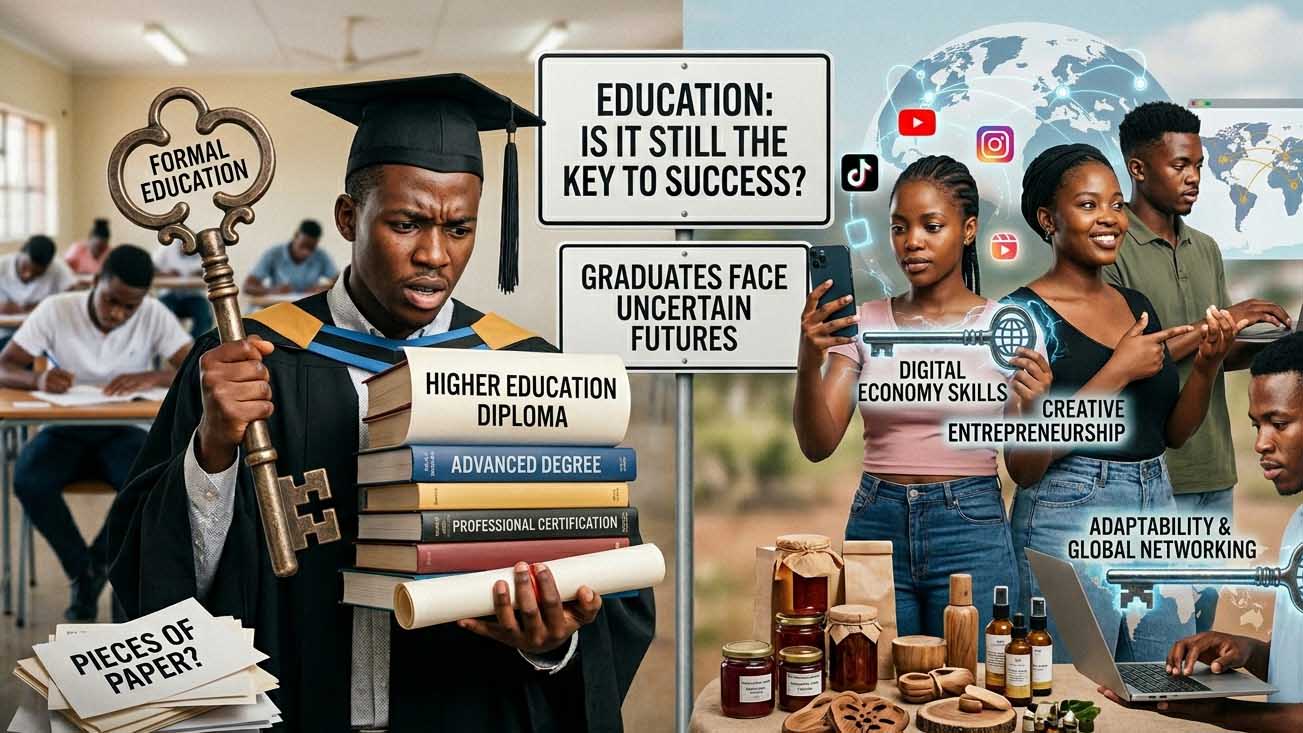
Next Monday, June 15, University of Eswatini (UNESWA) students at the Kwaluseni campus will start their second-semester examinations, with high hopes of excelling. As the examination season descends upon the university, with the library full and study groups occupying every available corner, some students are spending sleepless nights preparing for the upcoming examination that will determine their academic progress. This proves that thousands of young people continue to place their faith in education, believing that a degree will open doors to employment, financial stability and a better future.
Honestly, for generations, society has embraced the idea that education is the key to success, such that parents sacrificed their savings and they still do to pay school fees, students dedicate years of their lives to studying and governments invest certain amounts in educational institutions. The promise has always been simple: ‘Work hard in school, obtain qualifications and success will follow’.
However, in today’s reality, a new slogan is needed because the one that ruled seems to have lost its sweetness. Nowadays, even graduates are beginning to question whether this promise still holds true. The sad reality is that students’ hard-earned qualifications are slowly turning into pieces of paper decorated in their rooms, with no jobs in the country. The question stands: Is education still the key to success?
“I graduated in 2023 with a Diploma in Primary Teaching from a college based in Mbabane, but I haven’t been called by the Teaching Service Commission in my entire life. I had to start applying for a post I never practised for to make a living because I have children to feed,” said a graduate expressing her frustration.
Quite a number of graduates who invested years in higher education have turned to employment opportunities at the Matsapha Industrial Site, taking factory jobs to earn a living and support their families. This raises questions about the country’s ability to absorb skilled graduates into sectors that match their qualifications.
The country faces a critical challenge of youth employment, with many university graduates struggling to secure jobs despite possessing academic qualifications.
Every year, institutions of higher learning produce graduates in various fields, yet the labour market is unable to absorb them all. For that reason, degree holders find themselves unemployed for years, while others accept jobs unrelated to their qualifications. This situation has led people to argue whether education is still the key to success or was it ever the key from the start.
In the era of digital space driven by technology and innovation, skills, creativity, adaptability and networking appear to be just as important as formal education. In South Africa, content creators and social media influencers earn incomes that far exceed those of traditional eight-to-five employees. Using platforms such as TikTok, YouTube, Instagram and Facebook, influencers generate substantial revenue through brand partnerships, advertising, sponsorships and product endorsements. This has challenged the long-held belief that success depends solely on academic qualifications. Lately, it is not uncommon to see influencers earning in a month what some degree holders earn in a year.
The growing popularity of social media influencers does not necessarily mean that education has lost its value; it demonstrates that success in the 21st Century can be achieved through multiple pathways. Last month at the Eswatini Consumer Fair, local entrepreneurs made a strong impression, showcasing creativity, skill and innovation that exist within the country.
The exhibition featured a range of locally produced goods, including homemade jams and sauces, natural beauty oils and handcrafted wooden products. While youth unemployment in the country continues to shoot up, young people should start investing more on entrepreneurship. Expecting government to create jobs for graduates is valid, but how long will the wait last? Complaining about an issue and doing nothing about it does not help the situation; instead, it worsens it.
Education remains one of the most powerful tools for personal development and social mobility. It equips individuals with critical thinking skills, literacy and knowledge that can be applied in many aspects of life.
Doctors, teachers, engineers, journalists, lawyers and countless other professionals rely on education to perform effectively.
This is not a matter of education losing its capabilities and value, but rather that the people’s understanding of success has changed. A degree alone may no longer guarantee employment, but it can provide a foundation upon which individuals can build careers, businesses and opportunities. Nowadays, success requires a combination of education and innovation.
As the students sit their examinations, they should bear in mind that academic results are very important, but they are not the sole determinant of their future. Education remains the key, but it is no longer the only key.
To graduates, learn how to unlock opportunities using both qualifications and the ability to adapt to an ever-changing world. Education systems should adequately prepare students for the realities of the modern economy.


















Leave a comment