

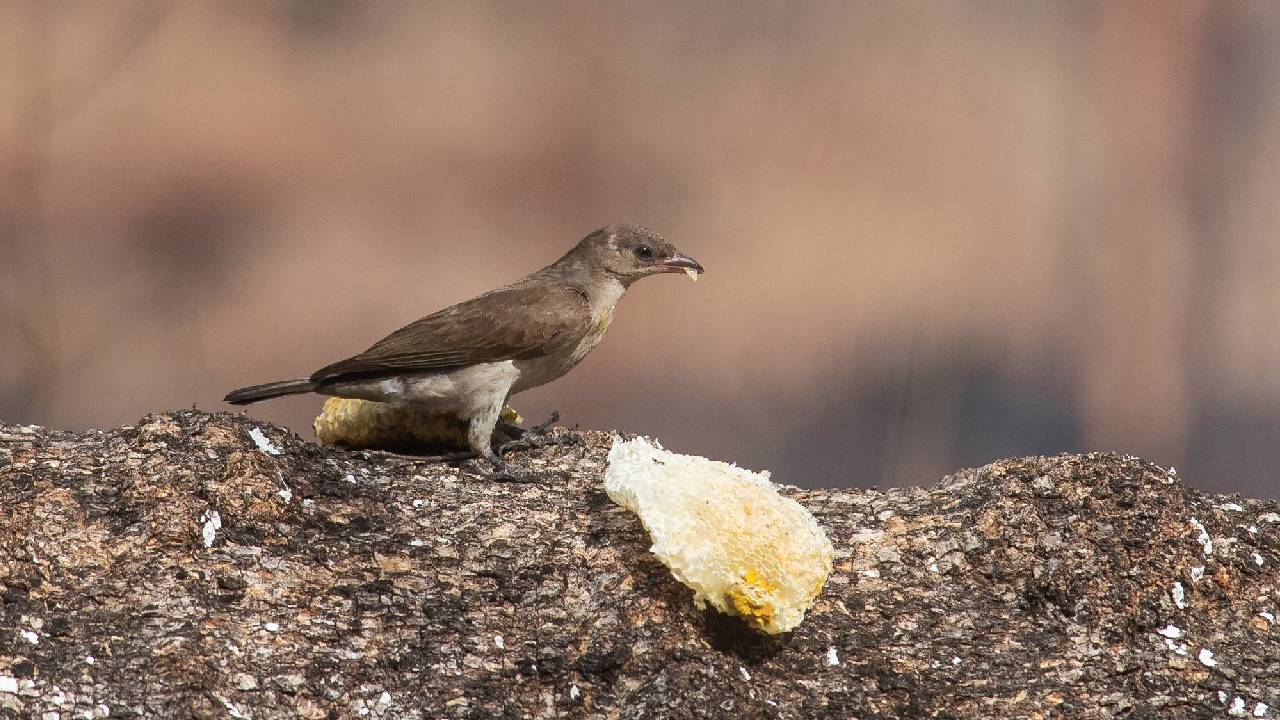
Deep in Eswatini’s hills and forests lives a bird with a remarkable secret. The Inhlava, or greater honeyguide, knows where wild bees hide their home and it is willing to show you. This small, brown wild bird has an unusual behaviour; it calls to people, then flies ahead, leading them to a hidden bees’ nest. The people break open the nest to collect honey and the bird swoops in afterwards to eat wax and bee larvae left behind.
This human-honeyguide partnership could be thousands of years old and was likely once common across Africa. Today, this friendship still blossoms in only a few countries and Eswatini is proudly one of them. A new study, the first to document the tradition in our country, shows it’s still alive and well. For lead Author Sanele Nhlabatsi and his team, it’s also about telling a Swati story in Swati voices.
Unlike in other honey-hunting cultures in, for example, Tanzania and Mozambique, honey-hunting in Eswatini is not just about making money. Most honey-hunts are for fun, especially among young boys tending to cattle looking for a sweet snack. “It is a relationship built on trust” says Nhlabatsi, who is a researcher affiliated to the University of Eswatini (UNESWA). “You don’t know exactly where the bird is taking you, but you trust that it will show you a bees’ nest, just as it also trusts that you will share.” Every one of the 77 honey-hunters interviewed as part of this study said they leave wax for the Inhlava.
Honey-Hunt
Many believe that failure to share with the bird could bring bad luck, even an encounter with a dangerous snake.Boys learn to honey-hunt from elders and friends, keeping the tradition alive. But times are changing. More children are in school, jobs pull people away from the land and forests are shrinking. Although there are worries that there will be less people interested in honey-hunting with the Inhlava in the future, the tradition will likely survive; sustained by cultural pride, the thrill of the chase and the simple pleasure of working together with a wild animal.
Now, Eswatini is officially on the map as one of the few places where people still walk alongside this wild bird. “This is part of our heritage” says Nhlabatsi. “It deserves to be widely known, here and around the world. This mutualism is an important part of our culture and the pride of young boys in many rural communities,” adds co-Author Gcina Dlamini, a Builder and active Honey-Hunter from Mlindazwe, Lavumisa. “We must work to conserve it”. So, in Eswatini – Inhlava still calls and people still follow.

















Leave a comment