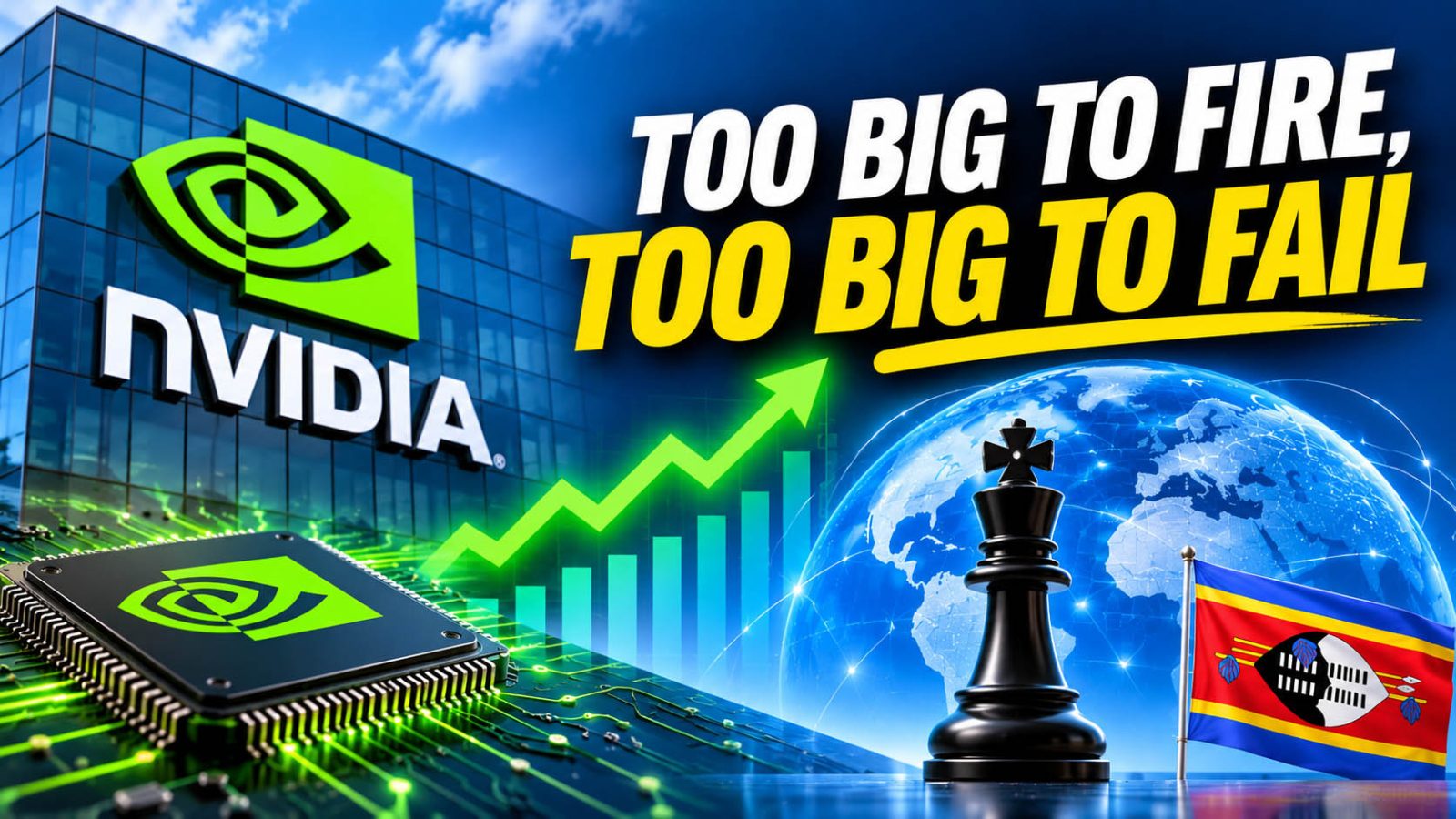
The world of artificial intelligence was shaken when leadership turmoil engulfed Nvidia, arguably the most important company in the AI revolution. A potential industrial espionage scandal involving Founder and CEO Jensen Huang and an alleged Chinese spy rapidly escalated into a corporate crisis, culminating in his resignation. Markets reacted swiftly and ruthlessly. On November 20, 2026, Nvidia lost more than a trillion Dollars in market value in a single day, delivering a clear verdict: Bring back our rock star CEO. At stake was not merely the fate of an executive, but the future direction of a company whose technology underpins the global AI ecosystem. The deeper question confronting economists is what happens when companies become too important to fail and celebrity chief executives become so influential that they are effectively too big to fire.
Mick jagger of AI
On the return of Jensen Huang Monday, Nvidia stock surged by approximately 30 per cent, instantly recovering hundreds of billions of Dollars in market value and signalling the market’s overwhelming endorsement of his leadership. The rebound was so dramatic that it overshadowed what would ordinarily have been the dominant story in global technology markets: The extraordinary valuation premium attached to AI firms such as Anthropic and the broader debate about the sustainability of AI-driven asset prices. Instead, investor attention shifted almost entirely to the return of Huang, reinforcing the perception that in today’s technology, economy certain individuals can become as strategically important as the companies they lead. It was a reminder that leadership charisma, strategic credibility and investor confidence can, at times, become assets almost as valuable as patents, factories and intellectual property.
Rent seeking
Saliently, beneath the excitement lies a more troubling question: Has the world become too willing to place profits before national security? Specifically, the role President Trump played in lobbying the Board to reinstate the CEO. Nvidia occupies a strategic position unlike that of almost any other corporation on the planet. Its semiconductors no longer power only video games and data centres; they increasingly underpin advanced defence systems, cybersecurity capabilities, scientific research, intelligence gathering and industrial innovation.
Debates over export controls, access restrictions and technological rivalry between the United States and China highlight a growing reality that artificial intelligence is no longer merely a commercial technology, but a strategic resource. In many respects, Nvidia has become the central bank of AI, controlling the supply of the advanced chips that power the global digital economy. As governments, investors and technology firms race to capture the benefits of AI, there is a danger that commercial interests may overshadow broader security considerations. Policymakers, therefore, face the difficult task of balancing innovation, competitiveness and economic growth with the imperative to protect strategic national and global interests.
Global south
Artificial intelligence promises unprecedented opportunities to boost productivity, improve public services and accelerate economic development. Yet the NVIDIA story reveals a deeper reality: Access to AI is increasingly controlled by a small number of companies, countries and geopolitical interests. Recent restrictions on advanced NVIDIA chip exports to China demonstrate that computational power is no longer merely a commercial resource, but a strategic asset influenced by national security considerations. If major economies can be denied access to cutting-edge AI infrastructure, developing countries have even greater reason for concern. This raises a critical question for Africa: Can the Global South participate meaningfully in the development of frontier AI systems or will it remain a consumer of technologies created elsewhere? Historically, developing economies exported raw materials and imported manufactured goods. The AI economy risks reproducing this pattern, with the Global South supplying data and consumers while the Global North captures value through ownership of algorithms, intellectual property and computing infrastructure.
Domestic implications
The Nvidia story carries important implications for the kingdom’s future competitiveness, productivity and economic sovereignty. As artificial intelligence becomes embedded in business, finance and government, there is a growing risk that local institutions could become dependent on foreign AI platforms, digital infrastructure and algorithms developed elsewhere. While these technologies can improve efficiency and decision-making, they may also deepen technological dependence if domestic capabilities are not developed alongside their adoption. This makes AI not just a technology issue, but a development imperative. Eswatini must invest in digital infrastructure, strengthen education in science, technology, engineering and mathematics and build partnerships that expand access to emerging technologies. The private sector must also shift from being a passive consumer of AI products to developing solutions tailored to local challenges. Ultimately, the key lesson from Nvidia is that countries controlling computing power are increasingly shaping global economic outcomes. Those left behind risk becoming spectators rather than participants in the next wave of economic transformation.
Closing spigot
The Nvidia saga illustrates how artificial intelligence is reshaping economic power, geopolitics and development. As AI infrastructure becomes concentrated among a few firms and nations, access to computing power is emerging as a strategic resource. Eswatini and the Global South confront the challenge not merely of adopting AI, but of building the capabilities, infrastructure and institutions needed to avoid technological dependence and participate meaningfully in the AI economy.